
We woke up this morning to the news that Australia has removed — simply, abruptly, and apparently for good — millions of under-16 teenagers from the largest social media platforms. What are we supposed to do with this?
Australia has become the first state in the world to take such a radical step: the ten most popular platforms — Instagram, Facebook, Threads, Snapchat, YouTube, TikTok, Kick, Reddit, Twitch, and X — were required to disable any account registered to a user under the age of 16. (The Guardian)
The law has now taken effect — meaning that more than one million under-16 users have already lost access to their accounts. Even before the ban was implemented, TikTok had deactivated 200,000 accounts, Reuters reported — and many others will follow in the coming days.
The justification is the classic one:
protecting children from algorithmic addiction, digital bullying, and harmful online exposure.
But what stands out is this: no one has ever attempted anything like this — removing an entire generation from the social network.
A generation switched off: What does Australia’s radical digital experiment tell us?
What happens when teenagers cry out:
“But my friends are there!”
What happens if it’s already too late — if technology has already become the space for social life, learning, and building a future?
Regulators expect tech giants to take “reasonable steps” — age verification, account deletion, blocking new registrations. Those who fail may face fines of up to 50 million AUD. (ABC)
But this raises a practical question: how realistic is this?
Within hours it became clear that many teenagers were trying to slip through the system’s cracks — staying unidentifiable or using false information. (BBC)
And we must ask: where does this lead?
Toward genuinely healthier kids?
Or toward an underground migration — into alternative, less regulated platforms?
And perhaps the most burning question:
Does society risk snatching something essential out of young people’s hands — their community? their civil platform for speech? their digital citizenship?
After the ban, many teenagers posted farewell, nostalgia, and “grief” messages, saying they felt their communities, friendships, and online spaces had been “lost forever.”
Others, however, welcomed the move, saying it might help them spend less time in front of screens.
Australia’s decision is a fascinating experiment: if it succeeds, other countries may follow.
But if it fails,
the price may not be addiction —
but isolation.
And is that not exactly the future we hoped to avoid?
What remains of our connection with our children if we force them offline?
[Here at home, we know this painfully well. It does not go well. Not sustainably.*]
On the day the ban came into force — December 10, 2025
— from this continent, it looks like this:
This step is both symbolic and radical — not just technological restriction, but generational rupture.
From Hungary or Transylvania, it may appear distant at first glance.
But the question is not geographical — it is political and societal:
How far are we willing to intervene in the space that has become one of the main infrastructures of social life?
Hungary has already experienced a digital-regulation explosion: the 2014 mass protest in Budapest against the proposed “internet tax” showed just how sensitive the society is to any attempt to restrict access to the digital sphere.
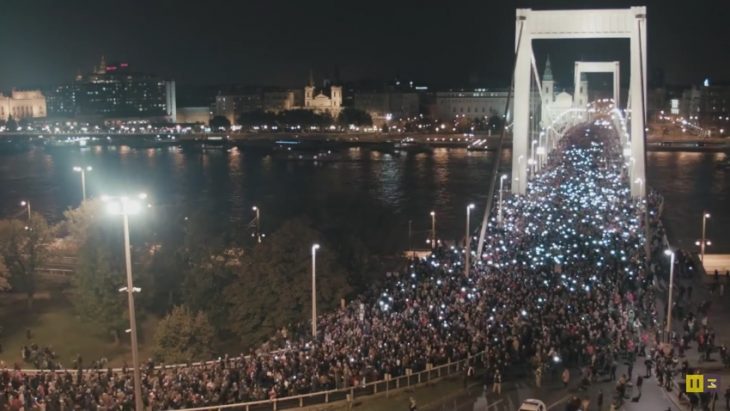
Budapest, 28 October 2014. Protest against the proposed internet tax. Source Index.hu, which estimated the crowd at 30–40,000 people. In addition to Budapest, demonstrations were held in Nyíregyháza, Pécs, Miskolc, Kiskunfélegyháza, Vác, Szeged, Debrecen, Békéscsaba, Komló, and Warsaw.
The protests were not merely against a tax — they were a defense of digital freedom, of the sense that the internet is not a luxury, but a basic condition of life. It was a clear message: interfering with the autonomy of the online world carries political risk.
Australia’s move is the opposite extreme: instead of pricing access, it removes access entirely for a whole age group. The goal is not fiscal but paternalistic — child protection, digital health, community development — yet the effect is the same:
a redrawing of the boundaries of freedom.
From Transylvania, the question is even more complex.
For minority communities, the online space is not merely entertainment — it is identity maintenance, community-building, the very arena of “diaspora publicness.”
Would a law restricting access on the basis of age have any legitimacy here?
Or would it provoke the loudest outcry precisely in the most vulnerable communities?
And perhaps the crucial question:
Is Australia really too far away for us to feel what is at stake?
Probably not.
Digital regulation spreads like a chain reaction.
If a major democracy introduces a tool no one has tried before, other states — especially in the EU, already pushing for stricter age verification and platform accountability — start paying attention.
The question that will inevitably reach us:
- What is child protection worth if it restricts digital citizenship?
- What is freedom worth if algorithmic exposure erodes young people’s mental health?
- Where is the boundary between the common good and self-determination?
- And who decides — lawmakers, parents, or the young people themselves?
Australia’s example matters not because it is “far away,”
but because it is the first attempt to legally redraw an entire generation’s digital life.
The question is when Europe — and within it, Hungary and Transylvania — will face the same dilemma, and how we will answer it.
The Big Question
Will this generation — Australia’s banned teens, Europe’s overwhelmed youth, Romania’s and Hungary’s digital natives — look at the internet the way our generation did?
As a limitless space where everyone is present?
Or as a restricted, fragmented, personal ecosystem
where people go only where they are treated well?
I — writing from Europe, from Romania, as a Seklerland-Transylvanian mother — have seen up close that long before Australia’s ban, the space we call the Internet had already begun to split.
During the enforced closeness of COVID, it became painfully clear how differently teenagers inhabit online worlds compared to what adults imagine.
They are not organized by the classic social media platforms.
They build their own private, often invisible realms.
By age ten they “set up servers”: rules, self-protection mechanisms, internal cultural codes, camouflage.This world is not the continuation of the old internet.
Nor does it follow the logic of mainstream platforms.
It is autonomous, fragmented, hidden.
If a new Internet is being born, this is its shape:
not a technological revolution, but a cultural withdrawal.
The first generation shaping itself not according to social media,
but according to its own measures.
The only real question is:
Is the world ready for that?
And — with anxiety — what will be the collateral damage in Australia?
[As for marketing, which has relied on observing youth behavior on social media — that industry has just been dealt a self-inflicted blow from above. I won’t predict what the Giants will do, but I suggest we watch closely, thoughtfully, and together.]
*Footnote
At home, many of us negotiate these boundaries every day as parents. In our own small “micro-systems,” we learn — sometimes the hard way — that forcing teenagers offline rarely produces trust or sustainability.
My own experience has been a process of mutual adjustment: agreeing on rules, respecting autonomy, finding the channels that work for both of us, and learning not to push by force. These lessons scale up: any system, whether a family or a state, only works if freedom and connection are held in balance.
Published in Hungarian by Transtelex (edited by Vig Emese Editor-in-Chief) on 11.12.2025: here.
Project manager and HR specialist by training, marketing-communications professional, Méray Prize–winning journalist, and author of two literary volumes. Her blog, Magánterület.tk, launched in 2002, was the first Hungarian-language blog in Romania. This new platform continues that work.
Photograph by Kovács Zsolt, featuring the author.
Taken in Székelyföld / Sfântu Gheorghe, Romania.
#musicHeals
-
Az arenaminda-gergelyedit projekt: LÉPJ BE

A Magánterület 2.0 – geXperience független microsite és ArtHeals fórum.
- Műfaja: Serious matters & elitbulvár. Glamdoire.
- Stratégiai cél: femicide-tribute.
- Fenntartó: saját büdzsé, saját szerkesztés, saját vétó. Különjogok: Arena Minda

Fotók: Attila Simon • Δούλος Ιωάννης • Gertrud Gozner